
2Q26 was influenced by a drop in oil prices, the strength of economic activity in the United States, and a slowdown in stock market valuations of companies closely linked to artificial intelligence (AI).
The price of oil fell sharply to levels similar to those recorded at the end of February, just before the beginning of the US-Israel offensive against Iran. This price drop came right after the signature of a Memorandum of Understanding between the United States and Iran, which includes a ceasefire extension and the beginning of a 60-day negotiation period, to last until mid-August. The agreement also includes the lifting of sanctions on Iranian oil and commitments to restore tanker traffic through the Strait of Hormuz. In any event, the situation remains fragile and, although tanker transit through the Strait of Hormuz has improved, the traffic flow remains far below levels prior to the conflict1.
The latest economic indicators show that the United States is performing better economically than the eurozone. The US economy has hardly been affected by the conflict in the Middle East and continues to be driven by investment in artificial intelligence (AI) and an increase in consumer spending, buoyed by the rise in the stock markets. In addition, business confidence and a stronger labour market reflect a robust economic environment.
For its part, the eurozone continued to grow, albeit at a more moderate pace, influenced by factors such as competition from China and rising energy costs. To mitigate these effects, the European Commission has simplified certain tax rules, allowing Member States to take advantage of new support measures.
In Spain, the impact of the conflict in the Middle East has been limited and has scarcely been reflected in economic activity. In fact, the macroeconomic data indicates that growth remained strong during the second quarter.
With regard to inflation, concerns remained high against a backdrop of a rebound in the key consumer and industrial price indices, largely driven by energy prices. In Spain, inflation – unlike economic activity data – was more clearly affected by the conflict in the Middle East, reaching 3.6% in June 2026, its highest level since June 2024.
Given this environment, at its meeting in June, the ECB raised the benchmark interest rate by 25 bps to 2.25%, as had been expected. President Lagarde declined to confirm whether this rise marked the beginning of a rate hike cycle and the market revised its expectations of ECB intervention downwards, no longer fully pricing in a second rate rise before December.
In the stock markets, optimism about AI cooled towards the end of the quarter following the strong rally observed earlier in the year, against a backdrop in which the market reacted positively to the IPO of SpaceX and also anticipates the stock market launch of Anthropic and/or OpenAI. Even so, the main stock market indices remained close to their all-time highs.
Trade tensions remained a key issue. The United States has moved forward with the implementation of new tariffs designed to ensure that they cannot be overturned by the courts. For its part, the European Commission considers the trade imbalance with China to be unsustainable and is looking into introducing new tariffs or import quotas. These measures form part of the European effort to reduce its strategic dependence. Additionally, the United States announced that it will not maintain its current trade agreement with Mexico and Canada beyond 2036, thus initiating a negotiation process that could go on for years.
In the corporate arena, Banco Sabadell carried out its first debt issue in Mexico for an amount equivalent to 200 million euros.
Finally, Sabadell’s share price ended the quarter with a year-to-date cumulative appreciation of +7.7%, adjusted for dividends, which is below the average of comparable Spanish institutions2 (+15%) and below the European banking sector average (+12.5%).
1. Volatile impact depending on geopolitical developments.
2. Comparable Spanish institutions include CaixaBank, Bankinter and Unicaja.
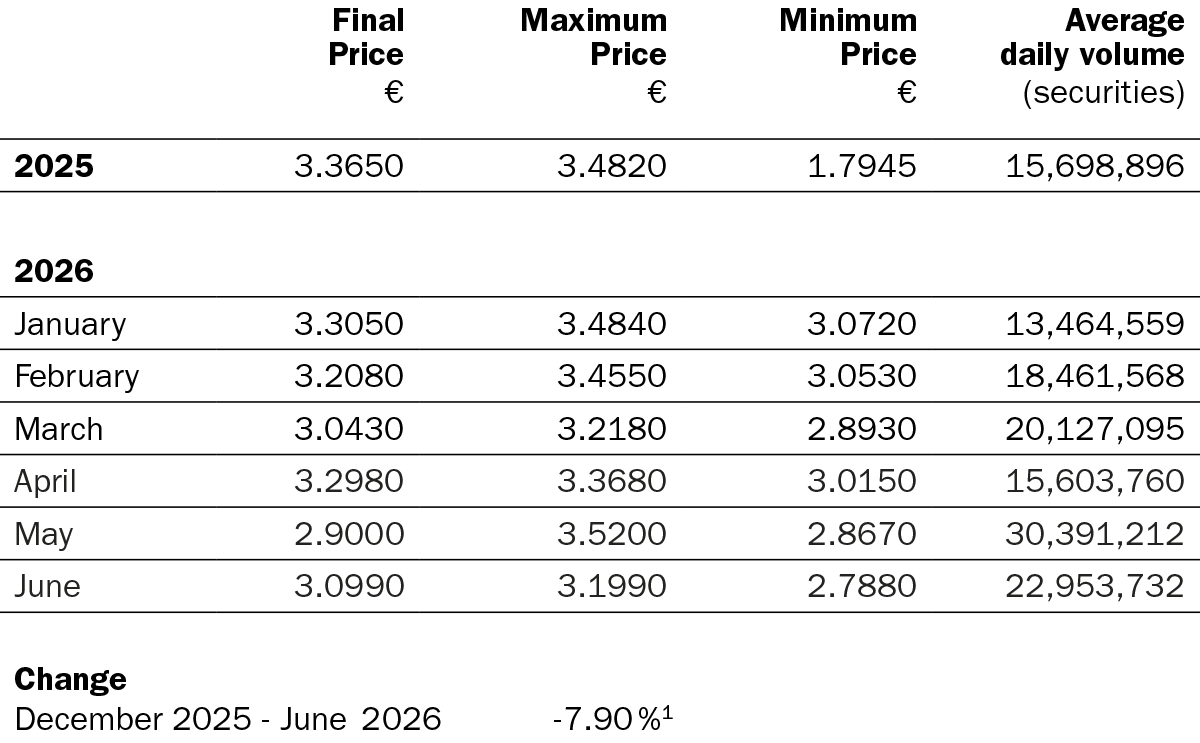
*Source: Bolsas y Mercados Españoles (Spanish stock market operator)
1. Price not adjusted for dividends. Adjusted value: +7.7%
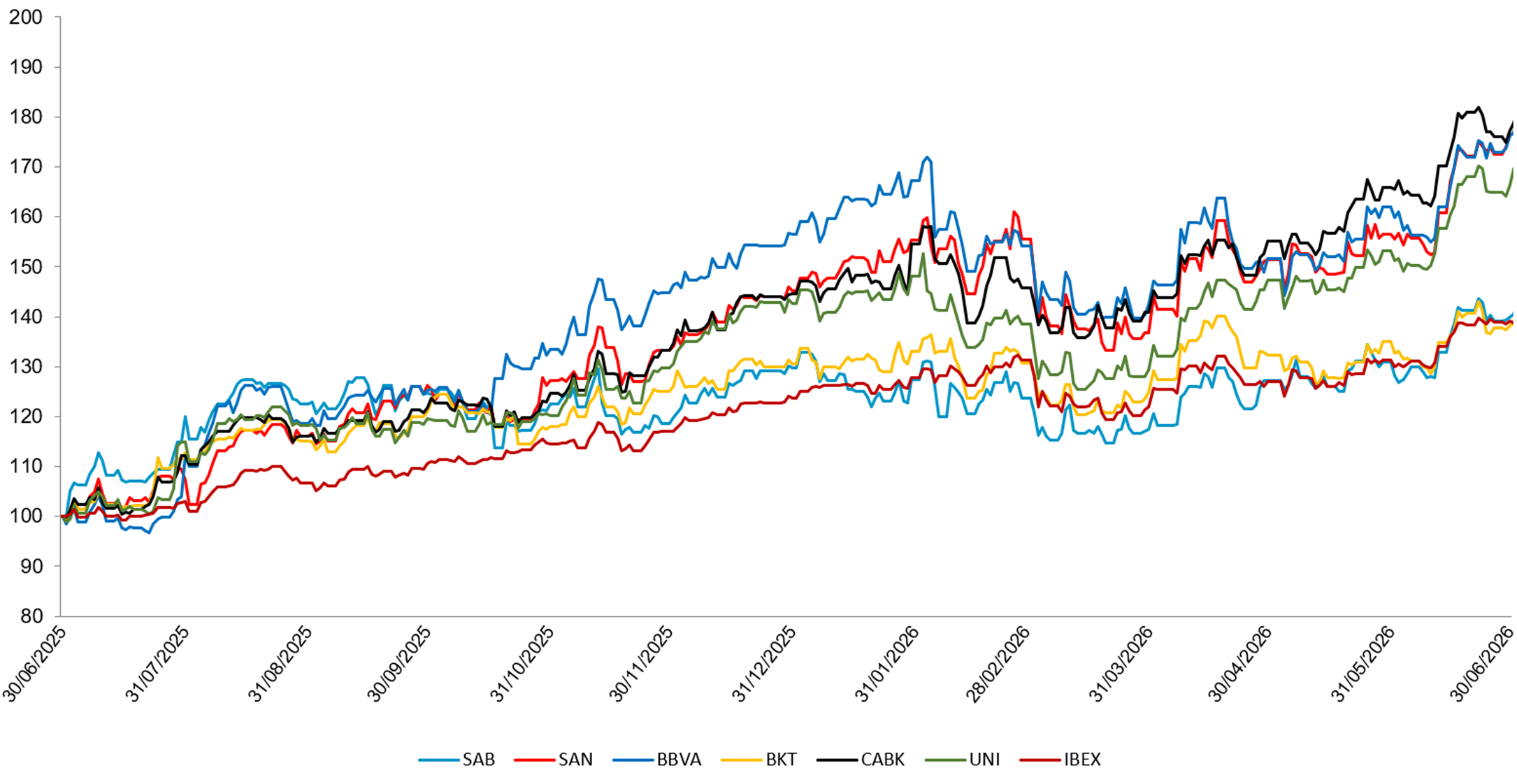
Source: Bloomberg. Data rebased to 100 at the start of the period, adjusted for capital increases, dividends, stock splits, etc.
(i) Past performance is no guarantee of future returns.
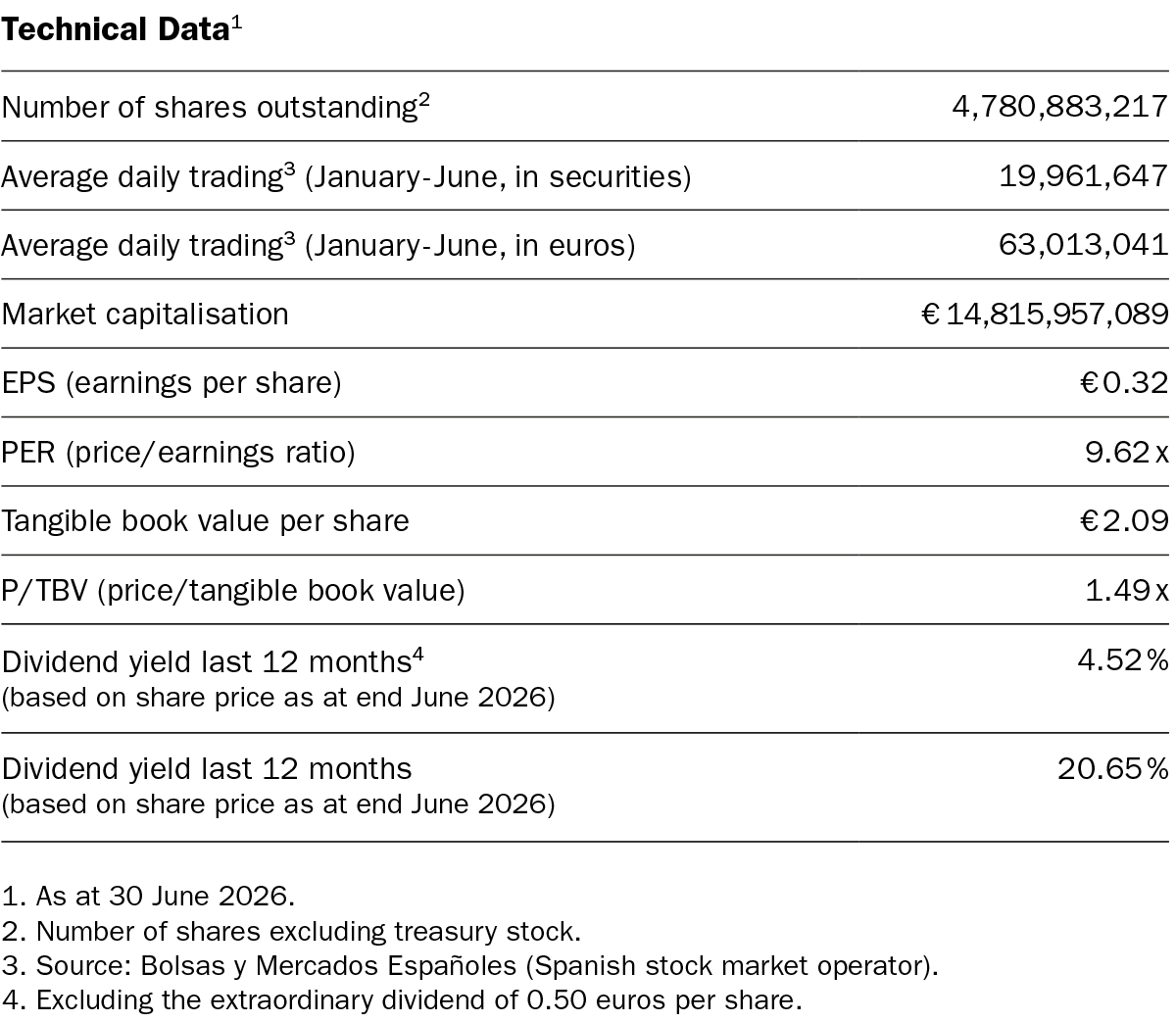
R.I. : 202600016-20-1-23104